
Concepts
What is an AI operating system? A definitive guide
The full definition: the five properties, the architecture underneath, what it isn't, the hard problems nobody solved yet, and how to evaluate one.
An AI operating system is an environment where autonomous agents, a searchable mesh of tools, and native applications run together under one permission model — the way a conventional OS unifies programs, files and hardware. The distinction that matters: a chatbot tells you how to do the work, an AI OS does it, in a place where you can watch, interrupt and audit it.
The term is young enough to be contested and old enough to be overused. This is the full version: what the phrase actually denotes, the architecture underneath it, what it excludes, the problems still genuinely unsolved, and the questions worth asking any vendor who uses the words.
The problem the term names
For the last few years, nearly every AI product could describe work but not perform it. Ask a chatbot to clear your inbox and you get a lucid explanation of how you might clear your inbox. The intelligence was real. The hands were missing.
Adding tool calling to a chat window helps, right until the work gets real. Then you notice what a chat window structurally lacks:
- No persistence. Every conversation starts from zero. Your tools, preferences and history live somewhere else, and you re-explain them constantly.
- No parallelism. One thread, one task. Real work is six things at once, most of them waiting on something.
- No surface. Where does a running job live? Where do you glance at what happened while you were in a meeting?
- No shared context. The agent reading your email and the agent updating your CRM don’t know each other exists.
- No permission model. “Can this thing touch my money” has no answer except vibes.
Every one of those was solved decades ago — by operating systems. Processes, windows, a filesystem, a scheduler, a permission model. The claim behind “AI OS” isn’t that we need new concepts. It’s that agents need the old ones, and nobody had brought them together.
Five properties
Definitions are only useful if they exclude things. Here are the five properties I’d insist on before the phrase means anything.
1. Agents are first-class processes. A running agent is something you can see, pause, inspect and terminate — not a message that scrolls away. It has a lifecycle, a state, and a place in the interface. If your “agents” only exist inside a chat transcript, you have a chat product.
2. Capabilities are discoverable at runtime. The system holds a catalogue of what it can do, and both you and the agents can search it. You shouldn’t have to remember what your AI is integrated with, any more than you memorise your applications folder. At scale this stops being a UI question and becomes the central engineering problem — tool definitions don’t fit in a context window, so selection has to be retrieval.
3. There is one permission model. Not per-app settings. One place that answers what any agent may do without asking, scoped per run, applied uniformly. This is the property most products claiming the label are missing.
4. State is shared and persistent. The agent that read the contract and the agent writing the summary operate on the same files, the same memory, the same history. Without this you have several assistants in a trench coat.
5. Work has a surface. Windows, a launchpad, a command bar, notifications. Somewhere for concurrent work to live and be observed. This sounds like decoration and isn’t: without a surface, parallel agent work is unobservable, and unobservable work is untrustworthy work.
Miss one and you have something else — often something good, but not this.
What it is not
Not a chatbot with plugins. Function calling is a capability an OS uses, not the thing itself. If the model calls one function you selected, in a turn you initiated, that’s a chatbot.
Not a copilot. A copilot lives inside one application and improves what you’re already doing there. An AI OS spans applications and can act while you’re elsewhere. The difference is initiative, and they coexist happily.
Not a workflow automation tool. Rules are deterministic and you draw them in advance. An OS hosts agents that decide their own steps. Both belong in most stacks, and reaching for an agent when a rule would do is an expensive mistake.
Not an agent framework. LangGraph, CrewAI and their peers are libraries for building agents. An OS is the environment agents run in, with the permissions, persistence and surface already solved. A framework gives you the loop; an OS gives you everything around it.
Not a literal operating system. Nobody is replacing Linux. The word is being used in its architectural sense — the layer that schedules work, mediates access to resources and enforces permissions — not its kernel sense.
The architecture underneath
Strip away the interface and an AI OS is five layers.
The model layer. Multiple models, selected per request. Sending everything to one frontier model is a pricing decision most teams make by accident — routing means classifying first, then matching the request’s shape to the model’s shape, with a fallback chain when a provider degrades.
The capability mesh. Every tool as data — a searchable record with a schema — rather than a hardcoded integration. Agents find a capability by meaning, read its schema, then call it. This is what makes a thousand tools tractable when a hundred already overflow a prompt. In Velaris the mesh holds 1000+ tools today, the Google Workspace connector alone contributes 47 live actions, and 148 built-in apps sit on top of it as operable surfaces.
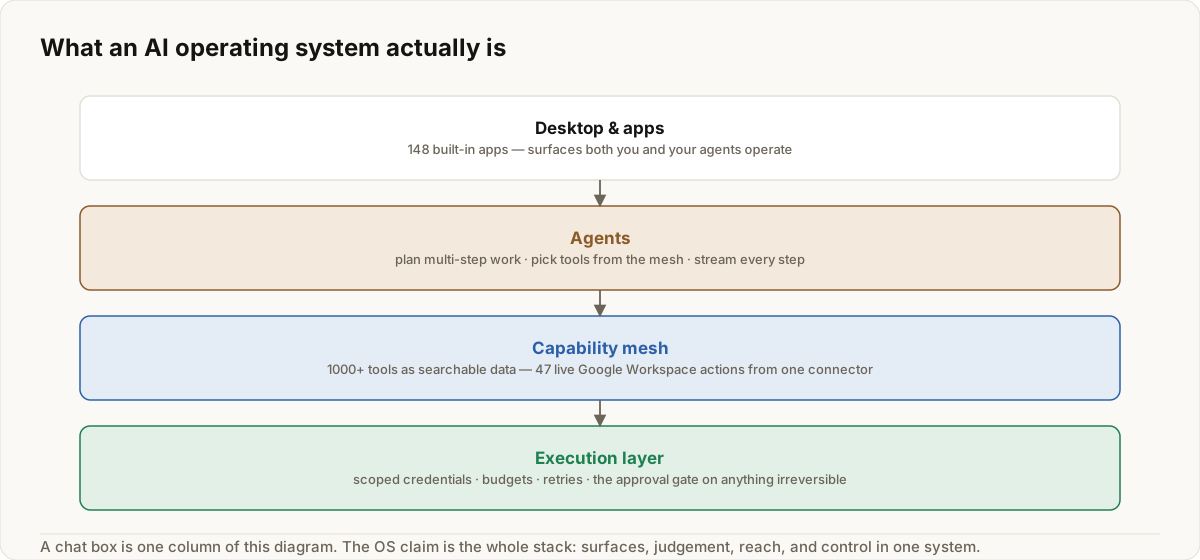
The execution layer. The part that actually calls things, holding scoped credentials, enforcing budgets, retrying transient failures, and refusing to proceed past a gate. Unglamorous and where most of the engineering lives.
The state layer. Files, run history, durable facts about the user. Deciding what to keep and what to discard is harder than it sounds — a context window is working space, not memory, and summarising too eagerly destroys exactly the specifics a long run needs.
The interface layer. Windows, dock, command bar. Where concurrent work becomes visible.
The layering matters because it’s what lets the pieces change independently. A new model provider shouldn’t require touching the permission model. A new tool shouldn’t require a code change anywhere.
Why a desktop
The desktop metaphor draws eye-rolls, so it’s worth defending precisely.
It isn’t nostalgia. It’s that windows solve parallelism and observability at the same time, and that combination is exactly what agent work needs. Three agents running concurrently need three places to be looked at. A chat transcript can only show you one thing at a time, in the order it happened, which is the wrong shape for work that’s happening simultaneously and finishing out of order.
The desktop also brings a vocabulary users already have. Nobody needs to be taught what a window, a dock or a search bar does. When the underlying idea is unfamiliar — autonomous software acting on your accounts — spending the user’s learning budget on novel interface conventions is a poor trade.
None of this means the interface must look like macOS. It means the properties — concurrent, observable, interruptible, spatially organised — are what agent work requires, and desktops are the interface family that already has them.
The permission model is the whole product
This is the part I’d argue hardest for, because it looks like a feature and is actually the architecture.
Tier every operation by effect. Reads run freely. Reversible writes run and are logged. Irreversible or outbound actions stop for a human. Credentials are scoped per run and expire with it, rather than being handed to the agent wholesale.
We expected this to feel like a tax. It did the opposite, because a hard rule forces harder questions: what is this agent about to do, exactly? Can it be described in one line someone can approve in two seconds? Can it be undone?
An agent that can explain its next step in one sentence is a better-designed agent. The gate imposed that discipline everywhere.
It’s also the only control that holds when prompt injection succeeds — and it will, because agents read email and documents written by other people, and no system prompt reliably beats instructions hidden in data. When injection works, a successful attack still lands in front of a person who did not ask for it.
Nobody wants an agent with root.
What one task actually looks like
Abstractions are easier to judge against a concrete run. Take “clean up my inbox — unsubscribe from newsletters and archive anything older than a month.”
The model layer classifies the request: multi-step, moderate complexity, no long-context requirement, and routes accordingly. The capability mesh is searched by meaning — the agent doesn’t know a tool called gmail.messages.list exists until it looks, then reads that tool’s schema before using it.
The execution layer runs the read steps immediately, because reads are free and reversible: scan 1,284 messages, group them by sender, identify the 23 newsletters you never open. That last fact is something you didn’t have.
Then it stops. Unsubscribing is outbound and effectively irreversible, so the permission gate produces one line you can approve in two seconds — with the concrete list, not the intent. You approve, it acts, and the summary says 23 unsubscribed and 412 archived. Nothing deleted, so all of it is reversible.
Meanwhile the state layer has recorded a replayable trace of every step, and a durable fact for next time: these senders are noise.
Five layers, one sentence of input, one decision from you. That’s the shape.
The problems nobody has solved
An honest guide has to include the parts that don’t work yet.
Reliability compounds badly. A step that’s 95% reliable is fine. Ten in sequence is about 60%. Long autonomous chains need checkpoints and verification, not better prompts, and this is the single biggest limit on how much you can delegate today.
Trust is earned slowly and lost instantly. One bad irreversible action costs more confidence than a hundred good runs earn. This asymmetry is why the conservative default is correct even though it makes demos less impressive.
Cost is unpredictable. An agent that retries can burn budget on something that was never going to work. Budgets must be enforced before each call, not reconciled afterwards.
Evaluation is genuinely hard. How do you know a prompt change didn’t break last week’s behaviour? Non-deterministic systems need test infrastructure most teams have never built — assert on the trace, not the prose.
Nobody has solved cross-agent coordination elegantly. Multi-agent orchestration works when something owns the plan and fails when agents call each other freely. The general case is unsolved.
Anyone selling you an AI OS who won’t discuss these hasn’t hit them yet.
How to evaluate one
Six questions that cut through positioning:
- Can I see a running agent, pause it, and kill it? If not, agents aren’t processes.
- What can it do without asking me? The answer should be a policy tiered by effect — not “everything”, and not “nothing”.
- Can I replay a past run step by step? No trace means no debugging and no audit.
- How does it choose among its tools? “They’re all in the prompt” doesn’t survive past a hundred.
- What happens when a tool call fails? Real systems describe retry, escalation or abort.
- Where does state live between runs? If the answer is the conversation, there is no state layer.
Where this goes
“AI OS” will read as obvious in a few years and slightly grandiose today. Categories usually sound that way right before they don’t.
The bet is narrow: as models improve, the binding constraint stops being intelligence and becomes coordination and trust. How do several capable agents work on your real accounts, concurrently, without stepping on each other, and how do you grant them enough access to be useful without granting enough to be dangerous?
Those are operating-system questions. They have operating-system answers, and the answers are mostly forty years old.
If you want the deeper cut on tool selection, that’s the capability mesh. For the trust architecture, human-in-the-loop approvals. Or drive one in the browser — no account, nothing to install — and come argue with us about where this is wrong.